 If you follow comics, you might have heard that Ernie Colón passed away last week after a battle with cancer. For me, it was sad but not unexpected news—I’d known about his condition since last year, when I’d started working with Ernie and his wife, Ruth Ashby, as the project manager on their graphic novel The Great American Documents, Volume II. (It’s a follow-up to their GAD, Volume I from 2014, both books packaged by Z File, Inc., the company owned and operated by our mutual friend, and my old editing boss, Howard Zimmerman.) The cancer had been in remission then, and Ernie had wasted no time in throwing himself into the work; he was one of those old-school artists whose one great hope always seemed to be that he’d be able to draw right up to the day they died.
He came mighty close, God bless ’im. Not only had all of us completed the work on American Docs II at the start of July and the publisher had informed us the book was finally off to the printer, but Ernie and I (as his editor) were already knee-deep into his next project: what would have been his first children’s book—published by me, of all people. And since it was Ernie, it wouldn’t be a conventional kids’ book—the story he’d concocted had a quirky, somewhat adult sense of humor more reminiscent of Mad magazine; we used to joke about how kids would enjoy it while their parents freaked out. He wanted to finish it; I wanted him to finish it.
But when Ruth e-mailed me a couple of weeks ago to let me know that the cancer had returned in an even more aggressive form, and that Ernie was entering hospice-at-home care…well, it was just a matter of time, unfortunately.
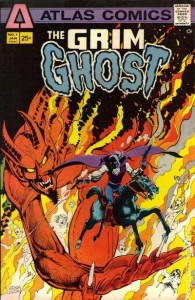 As a kid growing up, I’d probably first seen Ernie’s work in Harvey Comics’ Casper the Friendly Ghost and Richie Rich but didn’t know it, since Harvey never provided creator credits (years later, I was able to distinguish his art from others’ by the way he drew backgrounds). Probably the first mainstream comics work of his that I ever saw was in the 1970s, in Atlas Comics’ The Grim Ghost, a series (canceled with issue 3) about a 16th-century highwayman hung for his crimes and sent to hell, except the Devil returns him to Earth in the 20th century to collect souls.
The fluid way he drew action scenes, the way he experimented with panel placements, the art style that was somewhere between straight and cartoony—all of it grabbed my attention. It wasn’t Jack Kirby or John Buscema or John Romita Sr., but damn if there wasn’t just something about it I found really appealing—so much so that as the years passed I made it a habit to buy pretty much any comic he drew: Tigerman, Airboy, Magnus Robot Fighter, Battlestar Galactica, Cosmic Boy, Star Wars: Droids (he did the two-issue adaptation of Episode IV), John Carter: Warlord of Mars, Beetlejuice, The 9/11 Report, even the reboots of Casper. Okay, not New Kids on the Block—I did say “pretty much any comic,” after all.
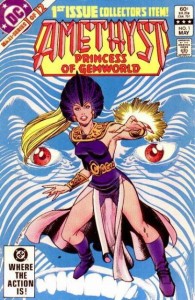 But it was in DC Comics’ young adult fantasy maxiseries Amethyst, Princess of Gemworld that I—and a lot of comic fans—got to see what Ernie could really do as an artist. Written by Dan Mishkin and Gary Cohn and published in the 1980s, it was Harry Potter before there was a Harry Potter, the story of a teenaged girl named Amy who discovers she’s really Princess Amethyst of a magical realm called Gemworld; when she crosses between the realms she becomes an adult but still with a teen’s mind. It’s one of the best works of Ernie’s career, but because it was a “girls’ comic,” because it was a fantasy, because it was YA it never got the attention it deserved. SyFy Wire just this year called it an “underrated classic.” If you’ve never read Amethyst, do yourself a favor and check it out.
 And then in the mid-1990s I got hired as an assistant editor by a book-packaging company called Byron Preiss Visual Publications (I’ve told stories in the past about working there). One of my earliest assignments was to take over a four-book anthology series that needed an editor—and an artist. It was either Byron or Howard who suggested Ernie, and when I called him he was as charming and funny and laid-back as the stories I’d heard about him said he’d be. He provided all the covers and pencils for the interior spot illustrations, but he hated the inking on the illos (not by him but another artist) so much that he insisted I destroy the art rather than return it to him. Absolutely demanded I wipe their existence from the face of the Earth.
They’re in my personal art collection. Hey, he said he didn’t want them…
At some point I started to call him “Maestro” whenever we began a phone conversation. I don’t know why, or where it came from, but I just did it, and I kept calling him Maestro right up to our last talk this past July. A friend of mine thinks it was my way of showing respect to someone older than me (Ernie celebrated his 88th birthday on July 10), but even more because I admired and respected him. Sounds right. He, in turn, called me Esteban.
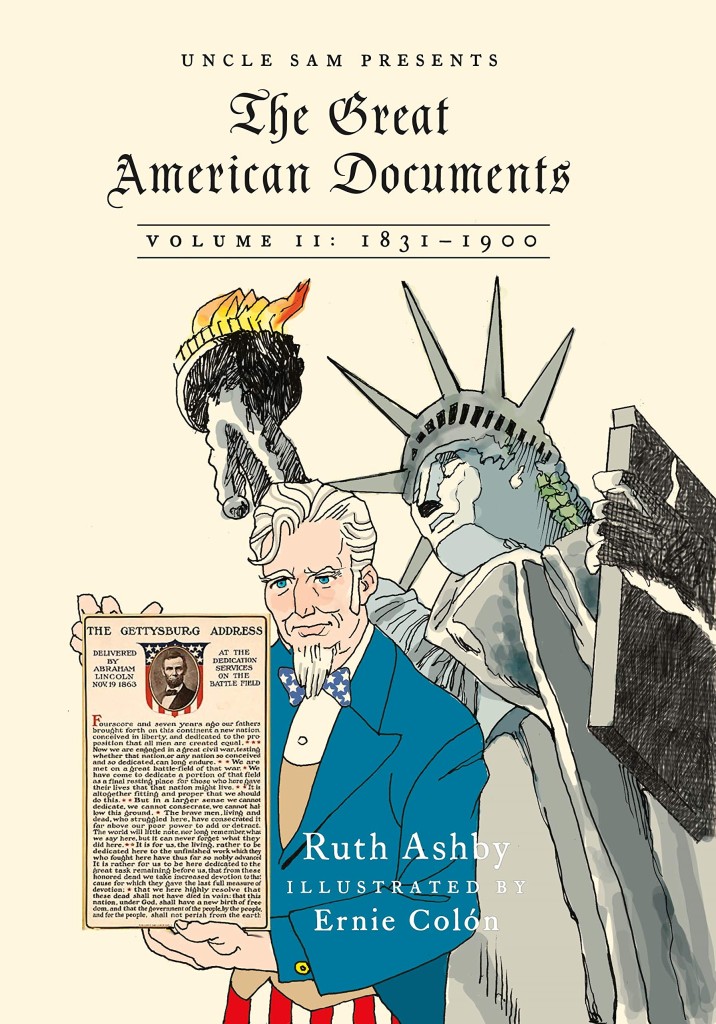 I had the pleasure of working with Ernie a number of times since then: I got him to contribute an illustration for a Marvel-related anthology I edited in 1998, The Ultimate Hulk. He drew a history of succubi for my graphic novel Lorelei: Sects and the City. He drew the Sholly Fisch–scripted “After Hours” in The Saga of Pandora Zwieback Annual #1. And of course there’s the upcoming Great American Documents, Volume II.
And when I went through a health scare in 2018 (long story), there was Ernie, calling me just about every day. The guy battling cancer, checking to see how I was doing.
Ask anyone who knew him and they’ll tell you Ernie Colón was a fighter, and he was, right up to his last day. He went fifteen rounds with that motherfucker cancer, but in the end it wore him down.
I just wish we’d been able to talk one last time before he left the ring.
Rest in Peace, Maestro. You’ve earned it.
Steve
 Yes, once again it’s time to celebrate and support the creations of independent comic book publishers—a notion fully supported by everyone here at ’Warp Central. Held the first Saturday in August, Buy Indie Comics Day has a pretty straightforward idea. To quote their mission statement:
 Speaking of indie comics you should buy (what? You thought there wasn’t an ulterior motive behind my promotion of this celebration? Hah!), we here at StarWarp Concepts have some comic and graphic novel titles that would be perfect for reading today!

 Richard C. White is the bestselling author of the licensed fantasy novel Gauntlet: Dark Legacy: Paths of Evil, and a popular writer of fantasy, science fiction, and crime tales, including Star Trek: Starfleet Corps of Engineers: Echoes of Coventry andThe Dark Leopard: Mouse Trap. But if you’ve been paying attention to his work, you’ll notice Rich has been building quite the backlist here at StarWarp Concepts. And now that he has a brand-new title on sale, I thought it was time to remind you of that backlist, since all the books are still very much in print (and as e-books) and readily available for order from the SWC webstore. Let’s review, shall we?

 While it’s true that Vampirella, the queen of the bad girls, is currently celebrating the 50th anniversary of her debut in 1969, there’s another sexy comic book character who’s marking her own anniversary in 2019: StarWarp Concepts’ first lady of horror, Lorelei!
 To celebrate Lori’s anniversary, we’re collecting those first small-press stories in
 Hey, comic fans! The fifth issue of The Formidables, the superhero series that I’ve been involved with as editor, is now on sale at online comics distributor IndyPlanet!
 July 12–14 was the latest gathering of Shore Leave, the annual Star Trek and sci-fi convention that marked its 41st year. And among the guests and vendors was our own Richard C. White, author of the recently published fantasy-noir story collection
 Hey, book lovers! Today’s the day when our e-book distributor DriveThru Fiction launches its annual Christmas in July Sale, during which you can purchase thousands of digital books at special prices! It runs from now to July 31—and yes, you’ll need to set up an account (it’s free) to take advantage of this promotion.
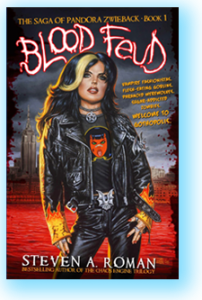 Blood Feud: The Saga of Pandora Zwieback, Book 1 is my young adult novel that’s perfect for lovers of dark urban fantasy. It introduces readers to Pandora Zwieback, a 16-year-old Goth girl who’s spent the last decade being treated for mental health problems because she can see monsters. It’s only after she meets professional monster hunter Sebastienne “Annie” Mazarin that Pan discovers she’s never been ill—her so-called “monstervision” is actually a supernatural gift that allows her to see into Gothopolis, the not-so-mythical shadow world that exists right alongside the human world. In Blood Feud, Pan, her parents and friends, and Annie are drawn into a conflict among warring vampire clans searching for the key to an ultimate weapon (or so the legend goes)—a key that just so happens to have been delivered to the horror-themed museum owned by Pan’s father.
 Terra Incognito: A Guide to Building the Worlds of Your Imagination is our popular how-to book for writers and gamers in which bestselling fantasy author Richard C. White (Gauntlet: Dark Legacy: Paths of Evil, The Chronicles of the Sea Dragon Special, Troubleshooters, Incorporated: Night Stalkings) takes you through the step-by-step process of constructing a world for your characters, from societies and governments to currency and religion. Included is an interview with New York Times bestselling author Tracy Hickman (Dragonlance) that discusses his methods of world building, as well as his creative experiences during his time as a designer for gaming company TSR, the original home of Dungeons & Dragons.
 King Kong: Our e-book-exclusive Illustrated Classics edition of the official novelization of the renowned motion picture, which is celebrating its 85th anniversary this year. Written by Delos W. Lovelace, based on the story by Edgar Wallace and Merian C. Cooper and the screenplay by James A. Creelman and Ruth Rose, the SWC edition of King Kong features scenes that didn’t appear in the final cut of the film—including the notorious “spider pit” sequence in which Kong’s human pursuers are attacked by horrific arachnids and insects. What makes our version special is that it contains six exclusive, original black-and-white illustrations by comics artist Paul Tuma, whose pulp-influenced style has appeared in the pages of The Twilight Avenger, Flare, and Dan Turner: Hollywood Detective.
 Carmilla: J. Sheridan Le Fanu’s 19th-century classic vampiric tale of love gone wrong. Laura is so desperate for a friend that when a young woman named Carmilla practically turns up on the doorstep of the castle owned by Laura’s father, she thinks her prayers for companionship have been answered. But as she comes to realize, Carmilla isn’t as interested in making friends as she is in spilling blood. Regarded as the one of the earliest female vampire tales—if not the first—Carmilla was an influence on author Bram Stoker in the creation of the vampire brides in his seminal novel, Dracula, and remains a popular character in fiction to this day. Our edition contains six original illustrations done especially for StarWarp Concepts by the super-talented Eliseu Gouveia.
 Superheroes and stories about walking, talking toys might be ruling the box office this summer, but there’s still plenty of room at the multiplex for other cinematic subjects—like vampires! Currently running in United Kingdom movie theaters is Carmilla, the latest screen adaptation of J. Sheridan Le Fanu’s classic tale of vampiric love and obsession. This version is written and directed by Emily Harris (Love Is Thicker Than Water) and stars Devrim Lingnau as the titular vampiress and Hannah Rae (Broadchurch) as Lara, Carmilla’s intended lover/victim.
 Before Edward and Bella, before Lestat and Louis, even before Dracula and Mina, there was the vampiric tale of Carmilla and Laura.
 On a more literary note, critics continue to enjoy this tale:
 Here at ’Warp Central, July continues to be party city when it comes to birthday celebrations: July 10 was painting legend Bob Larkin’s 70th; July 12 was author Richard C. White’s 60th; July 13 was comic-art legend Ernie Colon’s 88th. And now we have someone who’s reached the big five-oh!
 Behind that iconic cover painting by art legend Frank Frazetta (who’s probably best known for his equally iconic paintings of Conan the Barbarian and John Carter of Mars) and that distinctive costume designed by comic artist Trina Robbins, readers found horror stories by writers Don Glut and Nicola Cuti, and artists Billy Graham, Reed Crandall, Neal Adams, Mike Royer, Tony Tallarico, and Ernie Colon. And leading off the issue was “Vampirella of Draculon” by writer/co-creator Forrest J Ackerman (aka “the Ackermonster,” editor/creator of Famous Monsters of Filmland magazine) and artist Tom Sutton.

 In its pages you’ll find a breakdown of every Vampirella story that appeared during her Warren Publishing days from July 1969 to December 1982 (plus a list of the modern-day books that reprinted them); a checklist of every Warren Era appearance she made; a look at the six-book novelization series written by sci-fi and pulp-adventure author Ron Goulart and published by Warner Books in the 1970s; an examination of the awful 1996 movie that starred Talisa Soto of the Mortal Kombat movies as Vampi and featured a scenery-gulping performance from rock-god Roger Daltrey as Dracula; and a pretty extensive look at the history of Hammer Films’ Vampirella movie, announced in 1975 with model/actress Barbara Leigh and Hammer legend Peter Cushing as its stars, but which was never produced. Plus little-seen photos and other material pulled straight from the vaults of the Ackermonster by the Official Vampirella Historian, Sean Fernald, who also wrote the foreword. If you’re a Vampi fan, this will definitely be a book you need to pick up!
 Hey, folks, just a quick note to say I’ve had to cancel The ‘Warp’s appearance at this year’s MinCon, which takes place tomorrow at the Mineola Memorial Library.
 No events to show